|
This Article Appeared in the Star-Ledger,
May 31, 2004
Link to the Star-Ledger

Still missing
But
this flygirl has not been forgotten
Monday, May 31, 2004
BY JUDY PEET
Star-Ledger Staff
Late in the
afternoon of Oct. 26, 1944, a small, extraordinary, 32-year-old newlywed from
Jersey City climbed into the cockpit of a brand new P-51D Mustang at Mines Field
in southern California, wrestled the hulking fighter plane into take-off in
heavy fog and disappeared.
She was
Gertrude Tompkins Silver, the other Amelia Earhart; one of 1,074 women Air Force
pilots in World War II and the only one still missing.
For decades,
what ever happened to Silver has been a tantalizing mystery.
Did she stall
and spin right after take-off? Crash into the San Bernardino Mountains?
Commit suicide or just head off into the horizon in search of a new life.
Sixty years
later, the mystery finally may be solved, if enough money can be raised to
investigate the wreckage.
Silvers
remaining family, working with a small, dedicated band of aviation archeologists
(plane wreck buffs) think they have found the remains of her aircraft buried
under 15 feet of silt in Santa Monica Bay, not far from the back end of Los
Angeles International Airport (the former Mines Field). The family has no
intention of raising the lost plane. They just want closure, said her
grand-niece, Laura Whittall-Scherfee of Sacramento, Calif.
They want a
place to scatter some flowers and say a few words of good-bye to the stuttering
girl with beautiful hair from Kent Place School who traveled the world visiting
gardens and goats, before she found her real passion, flying,
Our goal is
just to try to find out what happened to my great-aunt before my grandmother
dies, said Whittall-Scherfee, referring to Silvers older sister, Elizabeth. It's
not like we sit around all the time wondering what happened to Gertrude, but
it's frustrating that it's been in limbo for so long.
Elizabeth
Whittall, 95, another extraordinary woman, actually doesn’t care that much if
the identified wreck turns out to be her sister.
I made my
peace with Gertrude’s disappearance long, long ago, and think any money spent
trying to get to her plane would be better spent on poor people or feeding
children, said Whittall, who after living in far-flung parts of the world for
most of her life, settled in Vero Beach, Fla.
But my
grandchildren have gotten so wrapped up in the excitement of finding Gertrude, I
don’t want to disappoint them, Whittall added. They have made it an adventure
and I definitely approve of adventure.
Adventure,
Whittall said, was held in high esteem by the Tompkins family.
They were
among the early settlers of Jersey City,
although upper middle-class comforts didn’t arrive until Gertrude and
Elizabeth’s father, Freeland Tompkins opened the Smooth-On iron cement factory
in 1895.
Iron cement
was used to repair water and steam leaks in cast iron products, such as boilers.
Smooth-On was an instant success in those expansionist times and Silver was able
to send his three daughters, Margaret, Elizabeth and Gertrude, to private
schools.
Their mother
had wanted to be a missionary in China, Elizabeth said, but was in too poor
health, so she passed her dreams onto her children.
Margaret, the
eldest, followed a more traditional path, going to Vassar and marrying a banker.
Elizabeth took the leap, however, moving to Damascus after graduating Wellesley
in the 1930s to teach at a Muslim school. She later lived in South Africa,
Madagascar and Egypt.
Gertrude, the
baby, had a rough start. She was shy, somewhat withdrawn, and plagued by a heavy
stutter. She did poorly at Kent Place,
and was sent to the country for a year, where she didn’t loose her stutter but
did gain a strong fascination for goats.
She graduated
from college with a degree in horticulture and returned to Summit, where her
family had moved, and raised goats. She visited the great gardens of the world,
traveling alone. She tried to convince the Australian government to invest in
goats, not cows, because they were ecologically and nutritionally superior.
Then she met
a young pilot, who taught her to fly. That was it Whittall said. She loved it.
She didn’t stutter when she was in a plane, or the whole time she was in the
WASP.
WASP, Womens
Air force Service Pilots, was an experimental program that hired licensed women
pilots to fly all military aircraft stateside, freeing up male pilots for
combat. After Silvers flyer beau and fiancée (whom her family will not identify)
was killed in combat, Gertrude was among the 25,000 women who applied to the
WASP, and among the 1,074 who were accepted and passed basic training.
Some of the
women were too small to handle the big fighter planes. Although slender, Silver,
at 5-foot-5, became certified on every type of military plane. She also got
married -- to Henry M. Silver, an accountant -- in September 1944, although her
superior officers didn’t find out until she disappeared.
Some friends
and family say she married on the rebound and regretted the decision. Others say
she may have been despondent, possibly suicidal.
Whittall and
her granddaughter say that is hogwash.
Gertrude
wouldn’t have killed herself, and even if she did, she was too proud of being a
WASP to take the plane with her, Whittall said. And we joked that she might have
taken off, but she was too close to her family to ever do that without telling
us. I don’t know what happened, but it wasn’t that.
What they do
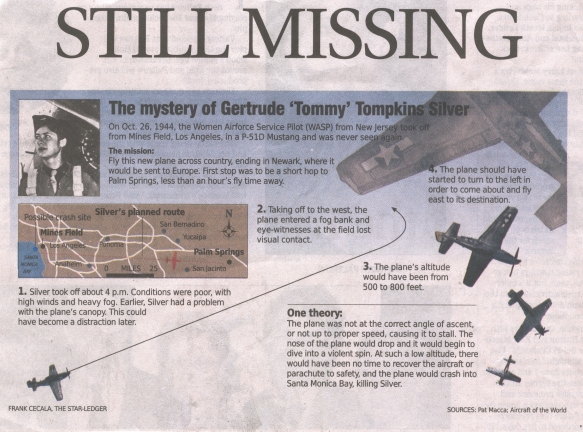
know is that three planes fresh from the factory were to leave Mines Airfield on
the morning of Oct. 26 and head east for delivery to the European front.
The flight
was delayed because of mechanical difficulties with Silvers plane. Among the
problems was a malfunctioning canopy, which would have made it impossible for
her to eject.
By the time
the three planes left in the late afternoon, conditions had deteriorated. Fog
had moved in and a nasty wind had whipped up. The pilots took off anyway,
circled around and headed for Palm Springs,
the first leg of their journey, said Pat Macha, a widely recognized aviation
buff who has helped find more than 1,000 downed planes.
Macha has
been helping the family search for Silver remains since he met her grand-nieces
husband at an air show more than a decade ago. Fascinated by the story, he
agreed to pick up were Whittall-Scherfees father left off on in his search in
the 1970s.
I looked at
the clips and the reports and talked to a guy who flew with her. She was good
and she was gung ho. There where no crybabies or ninnies in the WASP, said
Macha, a retired high school history teacher who helps families locate missing
planes.
At first we
thought she had made it to the mountains, and checked there, but all the wrecks
were accounted for, Macha said. But I knew that the day she took off, three
planes took off, but only two were seen circling back over the field.
Macha's
theory is that Silver crashed almost immediately after take-off. The fighter
plane was heavy, he said, and had a nasty tendency to stall and spin, which
means that if airspeed wasn’t achieved, the plane would go into an immediate
dive, giving Silver no chance to eject, or even react.
Using
expensive equipment that detects metal and mass on the ocean floor, Macha has
found lots of planes. But not the right one. Part of the problem is that the
plane probably would have broken up on impact and doesn’t look like a plane any
more.
Another
problem is that the area was used to deposit silt when the harbor was dredged
several years ago, which means the wreckage is buried under a small mountain of
sand.
Now, Macha
thinks he has found the right mound of metal, but we can't be sure until we get
in there and find out if it’s a P-51D, he said.
If it is, it
is almost undoubtedly Silvers plane, since hers was the only Mustang lost in
that region during the war. To find out will cost between $15,000 and $25,000,
that we really don’t have right now, said Whittall-Scherfee.
So we wait,
and try to raise more money and maybe get more tests that will better our odds,
Whittall-Scherfee said. Were looking for a sponsor, but people aren’t all that
interested in a women pilot who disappeared 60 years ago.
But we won’t
forget. Well never forget Gertrude.
|