|
Aircraft Wrecks in the Mountains and Deserts of the American West B-24D At about 7:30 AM on April 9, 1944 Consolidated B-24D 42-41128 USAAF departed March AAB in Riverside County, California on a routine training mission to simulate a long range bombing mission. The crew of ten men included no rank above 2nd Lt. The weather they faced was difficult as they headed northwest towards the great Central Valley of California. By 8:15 AM the crew of 42-41128 had encountered severe thunder storms associated with a rapidly moving cold front. According to eye witnesses, a B-24 bomber was observed spiraling down out of a cloud formation at 8:30AM impacting the desert floor some three miles southwest of the town of Mojave. All ten crewmen died instantly in the ensuing crash. The Army then sent a team to recover the bodies of the crew and remove the wreckage. The newspapers of the day paid little attention to another loss of plane and crew on the Mojave Desert where hundreds of others had gone down since 1941. All seemed forgotten in the years that followed until Don Jordan began looking for the crash site of 42-41128 in 2001. His information indicated the site to be ten miles south of the town of Mojave. When he asked me what I knew about this accident, I checked my files and found that the site was three miles SW of town. The next trip out Don found it. Scattered wreckage, impact crater, no apparent personal effects. I visited the site several times in 2003/4 while looking for other crashes in the area and noted that the wreckage of 42-41128 covered about four acres of scrub desert and that only 1-2% of the plane remained on the surface. In late July 2005 Marcia Shealey, the niece of Sgt. Michael Rudich, radio operator aboard 42-41128, e-mailed me regarding the possible return of a few keepsakes from the crash site for her two sons. As I was traveling out of the area I told Don about Mrs. Shealey's request. Don returned to the crash site, that we had visited together some months before, and did some poking around on the hunch that personal effects might be found there, and indeed they were. The discoveries included the dog tag of navigator, 2nd Lt. Donald J. Orth, numerous coins, a pocket watch, and rings, one of which was engraved with the name of gunner, Sgt. William C. Mahan. All artifacts were found by the team in the crater, except one small keepsake ring found by my son, Pat J. Macha. This keepsake ring was located in the brush nearby and was probably worn by a crewmen on his dog tag chain. Along with the personal effects we found, were a number of human bones. This was not unusual as the impact buried the B-24's nose several feet into the desert, thus concentrating remains in one place where the dog tag of 2nd Lt. Donald J. Orth was found. At this point we called me in the Pacific Northwest asking what procedure should be followed. I recommended that we talk with San Bernardino County Deputy Coroner David Van Norman, who immediately contacted the Kern County Coroner's Office for us. Also contacted were the USAF Mortuary Services at Edwards AFB. The Air Force in turn said this case should be handled by the Army, as the crew of 42-41128 were United States Army Air Force personnel. The US Army then elected to work with the Kern County Coroners Office, who in turn accepted ex-officio assistance from San Bernardino County Coroner's Office. On Saturday August 20, 2005 Kern County Coroner Investigator Kelly Cowan, San Bernardino County Deputy Coroner David Van Norman, Walt Witherspoon, Don Jordan, Allison Gatlin of the Valley Press, Gil Reza of the Los Angeles Times, Bob Smith of the Desert News, and myself gathered at the crash site. The coroners working together recovered the partial remains of one individual. The Army, working in concert with the Kern County Coroner, will complete recovery efforts at the crash site in the near future. Due to Army/Coroner regulations, until the investigation is completed this site remains off-limits to all visitors. Kudos to Mrs. Marcia Shealey for prompting us to travel back in time to remember not only her family member lost so long ago, but the nine other crewmen who died here too. The process of returning personal effects to next of kin has already begun.
Update:
Update:
Articles
Click on thumbnail to see large view! |
|
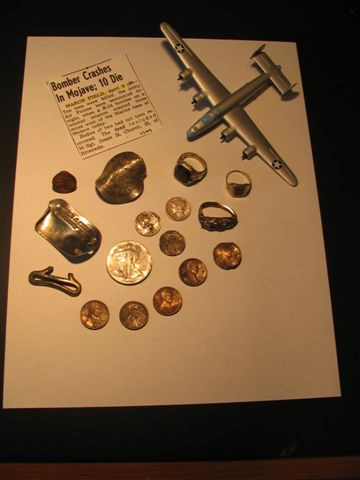
Artifacts found at the crash site of B-24D
#42-41128, a brief newspaper story, and 1/200th scale model of a B-24D. |
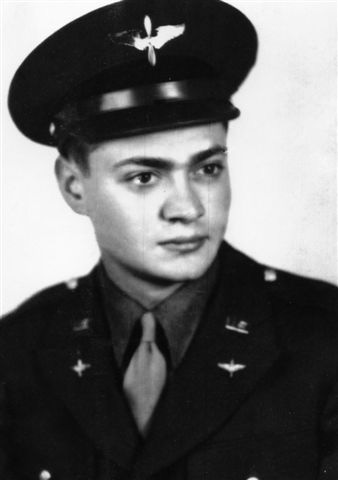 Sgt. Michael Rudich USAAF (1924-1944) radio operator aboard #42-41128. ( Photo courtesy Marcia Shealey) |

Kelly Cowan, of the Kern County Coroner's Office,
and David Van Norman of the San Bernardino County Coroner's Office work at the
impact site of #42-41128 in an effort to identify human remains. |
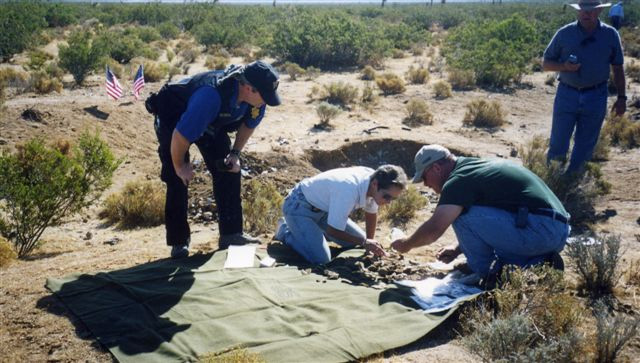 Coroners Kelly Cowan and David Van Norman examine the impact crater for bone fragments and personal effects. The flags in the background are always brought to crash sites where military personnel lives have been lost. |
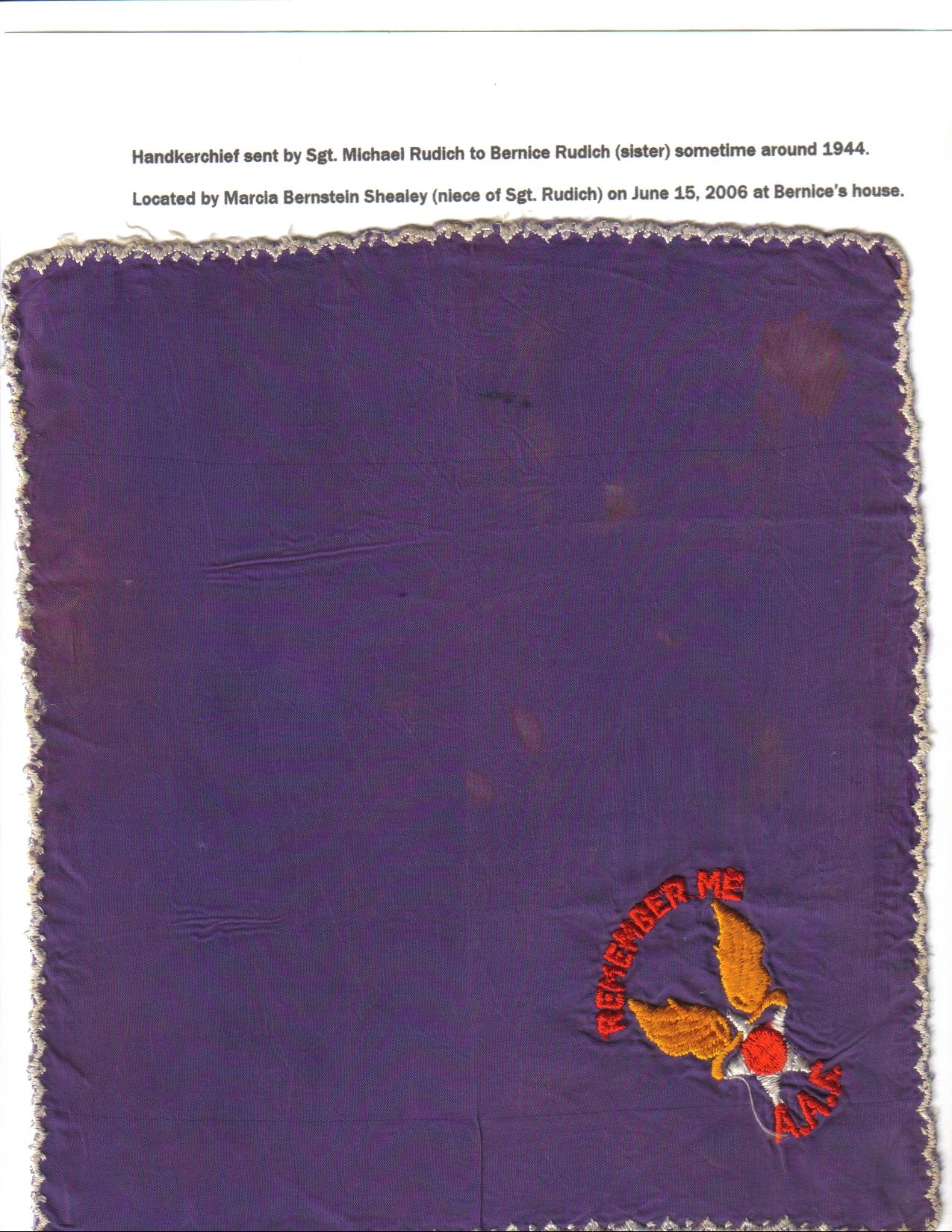 Shortly before his death in Consolidated B-24D #42-41128 on 4/9/44 Sgt. Michael Rudich mailed this keepsake handkerchief to his sister, Bernice, in South Carolina. Prior to Bernice’s death in 2007 her daughter, Marcia Shealey, came upon the handkerchief and her mother said it was the one mailed to her during WWII by Marcia’s uncle. The embroidery says it all, “Remember Me”. Thanks to Marcia Shealey for this memento photograph we always will. |
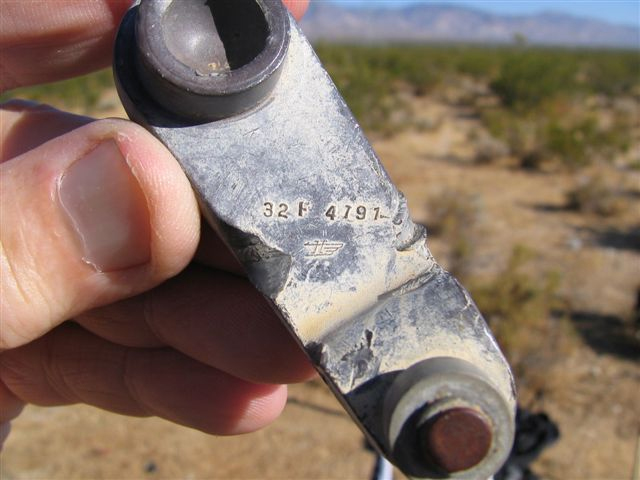
Part from 42-41128 with prefix 32F-4797-5. 32
followed by a letter then dash indicates Consolidated B-24 aircraft. This prefix
number does not, however, describe the version of |
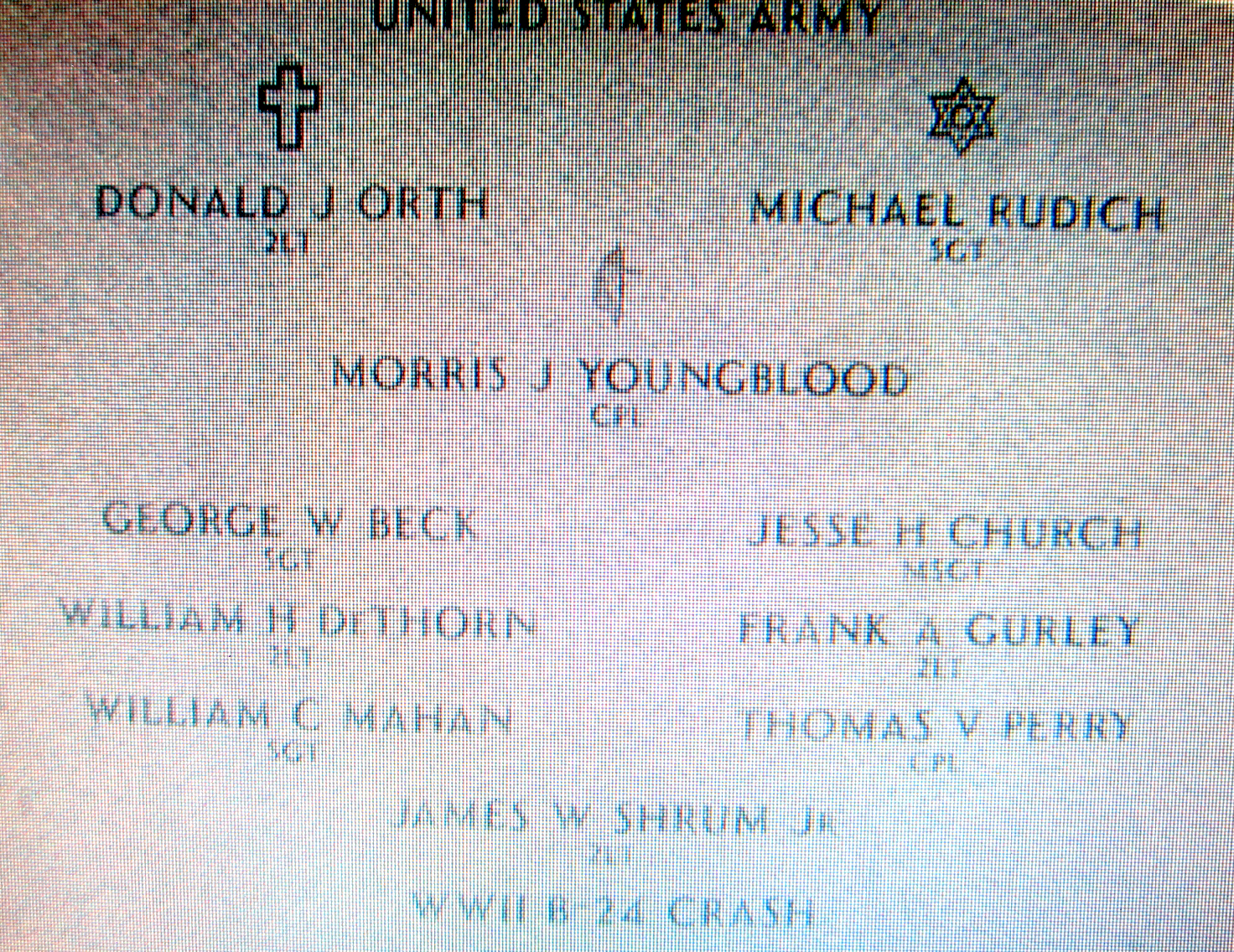 The ten man crew of USAAF Consolidated B-24D #42-41128 who died together on 4/9/44 have at long last been buried together at Arlington National Cemetery in a place of honor. (Photo via Marcia Shealey) |
|
|
|
|